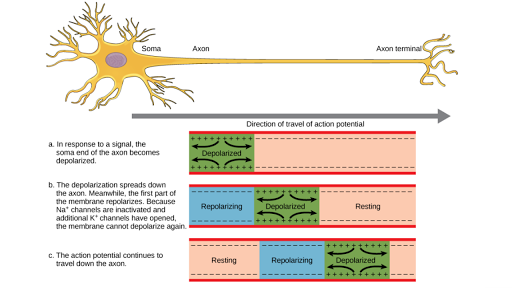
An action potential propagates. During the depolarization phase the gated sodium ion channels on the neurons membrane suddenly open and allow sodium ions Na present outside the membrane to rush into the cell.
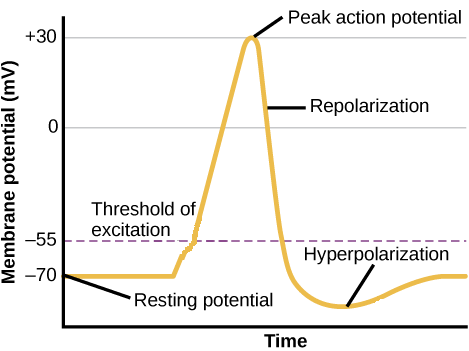
Depolarization Hyperpolarization Neuron Action Potentials Article Khan Academy
It consists of four phases.

During repolarization of a neuron. Repolarization is the process which returns the neuron cell into its resting potential after depolarization by stopping the inflow of Na ions into the cell and sending more K ions out of the neuron cell. What does depolarization of the heart mean. The membrane potential is eliminated.
During an action potential the first stage is depolarization in which sodium ion channels open causing an influx of sodium ions into the neuron. What happens to sodium channels and potassium channels during repolarization of a neuron. The repolarization phase usually returns the membrane potential back to the resting membrane potential.
An action potential propagates along the cell membrane of an axon until it reaches the terminal button. Hypopolarization depolarization overshoot and repolarization. Repolarization is the phase that follows depolarization.
In depolarization the neuron cell body has a positive charge. Potassium channels close preventing further loss of positive ions. Hypopolarization depolarization overshoot and repolarization.
1 2 The process begins when the neurotransmitter acetylcholine ACh is broken down catalyzed by the enzyme acetylcholinesterase AChE which is present in the postsynaptic membrane and synaptic cleft. Potassium leaves the neuron with the concentration gradient and electrostatic pressure. Both potassium channels and sodium channels remain closed the sodium channels close followed by opening of the potassium channels both sodium channels and potassium channels remain closed.
The first step is depolarization during which sodium ions flow into the cell and increase the membrane potential. Polarized state of a resting neuron where the membrane is negative on the inside and positive on the outside opposite charges. In repolarization the neuron cell body has a negative charge.
Most cells in higher organisms maintain an internal environment that is negatively charged relative to the cells exterior. Both are regulated by the opening and closing of ion channels. In neuroscience repolarization refers to the change in membrane potential that returns it to a negative value just after the depolarization phase of an action potential which has changed the membrane potential to a positive value.
At the peak of depolarization the sodium channels close and potassium channels open. When not signaling a neuron is hyperpolarized meaning it has a negative charge when compared to the outside. The falling or repolarization phase of the action potential is dependent on the opening of potassium channels.
Depolarization and repolarization are two events that occur on the cell membrane of nerve cells during the transmission of a nerve impulse. Then during repolarization potassium ions flow out of the neuron and bring the. What are the steps of depolarization.
Following a brief period of depolarization the postsynaptic membrane repolarizes to its resting potential within a few milliseconds ms. The efflux of potassium ions results in the falling phase of an action potential. During action potential repolarization the relative charge of the neuron is returned to its resting state.
The ions pass through the selectivity filter of the K channel pore. At the synapse of a motor neuron and striated muscle cell binding of acetylcholine to nicotinic acetylcholine receptors triggers a rapid increase in permeability of the membrane to both Na and K ions leading to depolarization an action potential and then contraction. Once 30 mV is reached the potassium channels begin to open and the sodium channels close.
This causes the membrane potential to reach approximately 40mV from a resting membrane potential of -70mV. An action potential is caused by either threshold or suprathreshold stimuli upon a neuron. Sodium-potassium pump is active during both events.
When the potassium channels open potassium rushes out of the cell to try and balance out the charges on either side of the membrane. After the signal ends the cell goes through repolarization where it returns to its original negative polarization. The sodium-potassium pump is turned off.
Depolarization of the heart leads to the contraction of the heart muscles and therefore an EKG is an indirect indicator of heart muscle contraction. During repolarization of a neuron sodium channels close and potassium rushes out of the cell to temporarily re-establish the membrane potential. It occurs just after the depolarization phase of membrane.
When an action potential signal travels across the axon it causes the cell to depolarize or become more positively charged. Action potential in a neuron showing depolarization in which the cells internal charge becomes less negative more positive and repolarization where the internal charge returns to a more negative value. During the repolarization phase of an action potential the potassium ions diffuse out of the cell and active transport begins.
Difference Between Depolarization and Repolarization. It consists of four phases. Repolarization is a condition of the membrane potential which results into a negative value of electrical potential across the membrane.

Repolarization Of The Postsynaptic Neuron Membrane

Q What Happens In The Depolarization Of A Nerve Studentrdh Blog
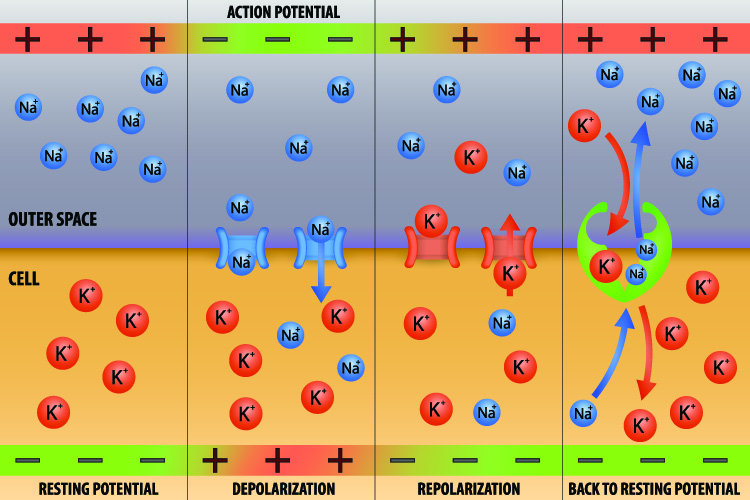
Action Potential The Definitive Guide Biology Dictionary
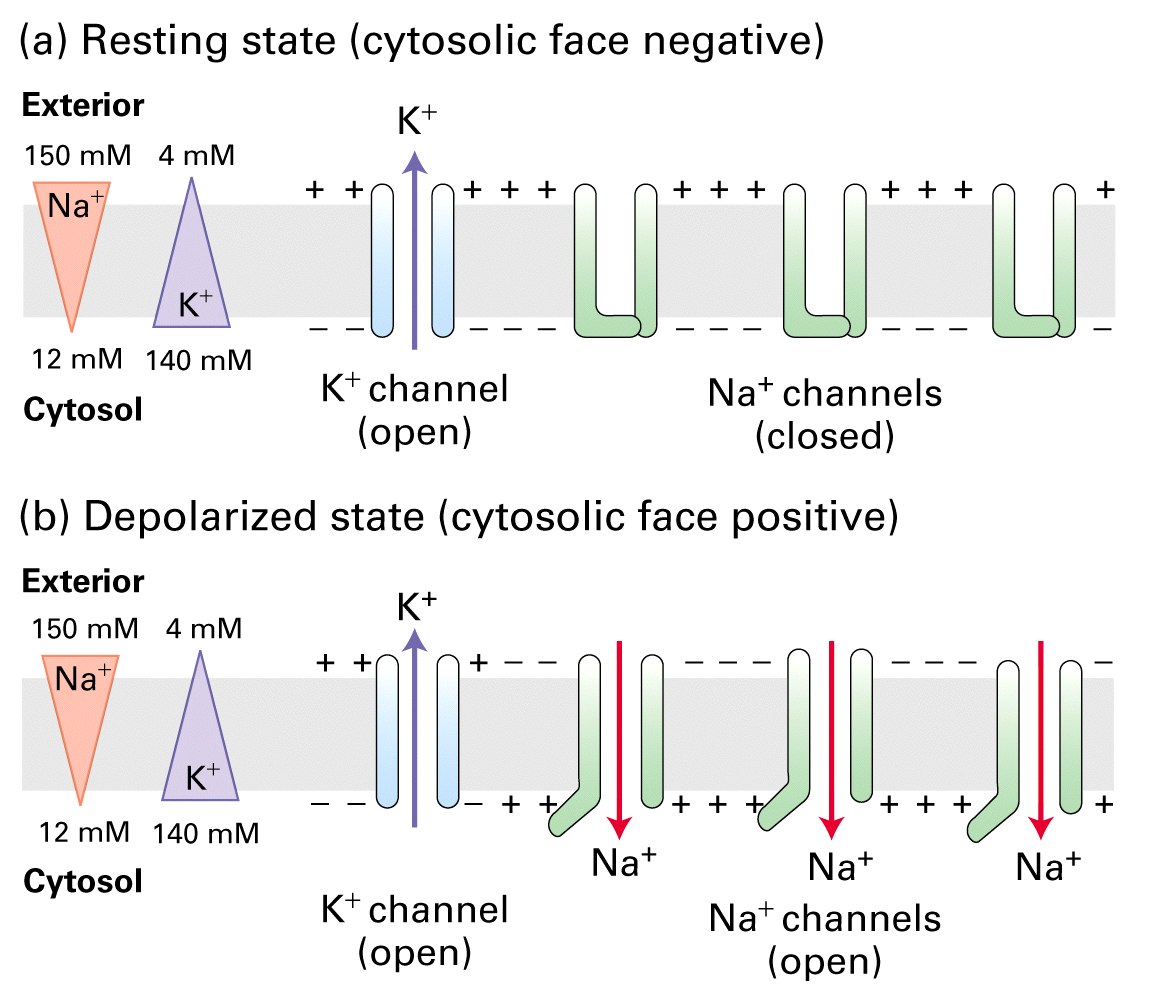
Action Potential
Depolarization Hyperpolarization Neuron Action Potentials Article Khan Academy