For example 10 2 8 but 2 10 -8. The associative property does not apply to division.
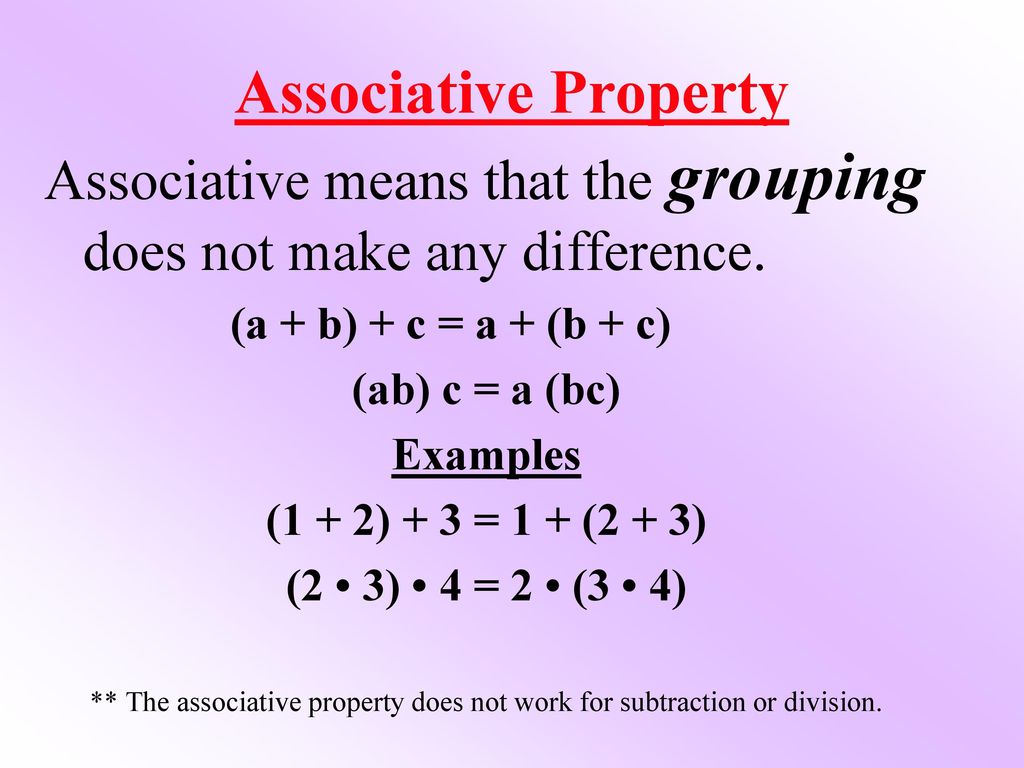
Does The Associative Property Apply To Subtraction Property Walls
The following table gives a summary of the commutative associative and distributive properties.
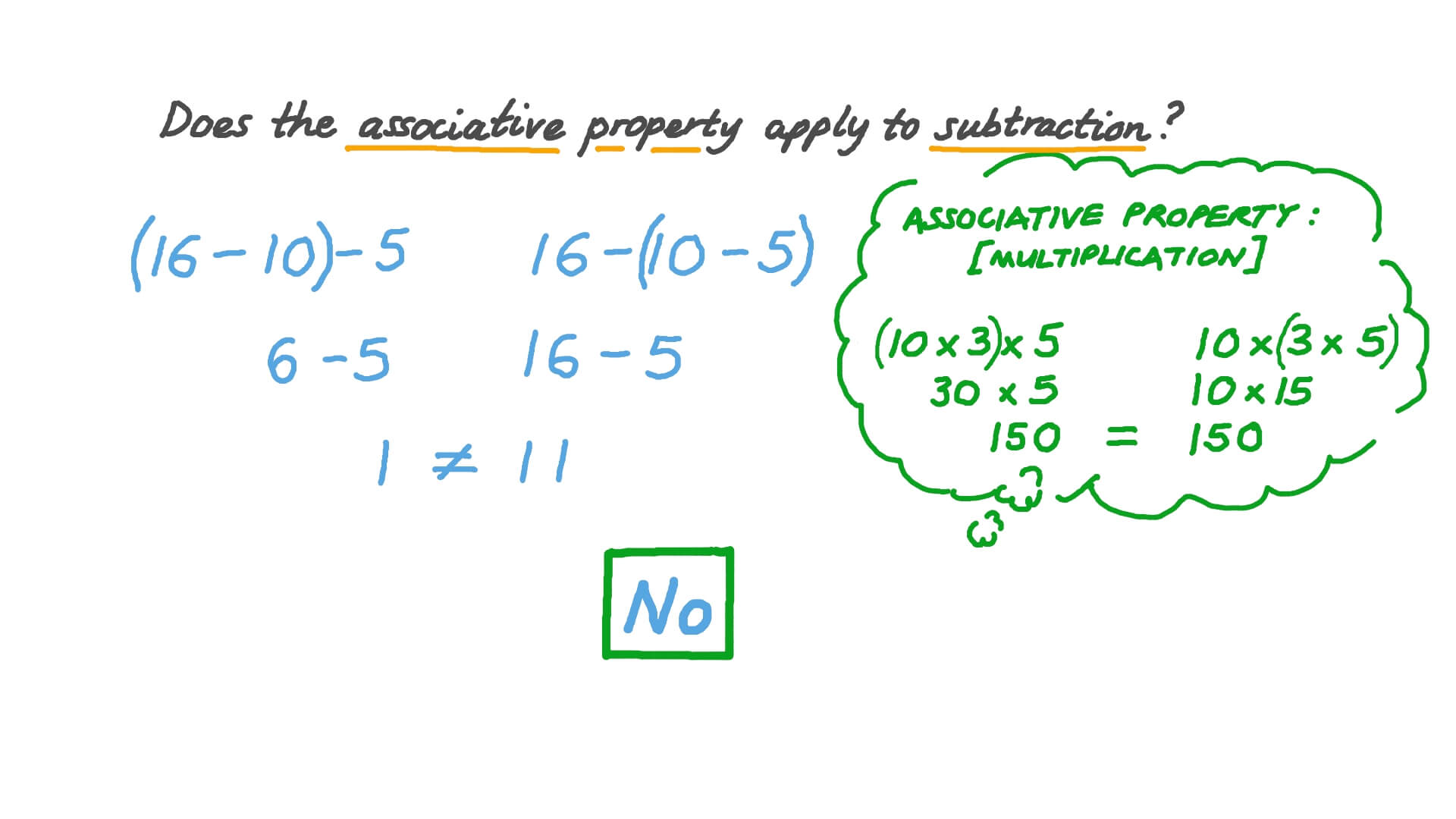
Does the associative property apply to subtraction. 3 2 1 3 2 1. However we cannot apply the associative property to subtraction or division. This can be observed from the following examples.
This law holds for addition and multiplication but it doesnt hold for subtraction and division. The associative property does not apply to subtraction. An operation is commutative if a change in the order of the numbers does not change the results.
It is important to note this distinction because the commutative property does not apply to the operation of subtraction. For instance 5 minus 3 does not yield the same as 3 minus 5. Subtraction is not commutative.
Use the associative property to change the grouping in an algebraic expression to make the work tidier or more convenient. The associative property would state that if you were dividing real numbers changing the. Numbers that are added can be grouped in any order.
This means that the order of the numbers in the subtraction does matter. Here is an example which shows why it cannot work with subtraction. Scroll down the page for more examples and explanations of the number properties.
We can look at the subtraction 10 2 by using counters. An example of the associative property in addition is. However unlike the commutative property the associative property can also apply to matrix multiplication and function composition.
The commutative property does however apply to. All 3 of these properties apply to multiplication. In other words if you are adding or multiplying it does not matter where you put the parenthesis.
The Distributive Law is the BEST one of all but needs careful attention. 3 lots of 24 is the same as 3 lots of 2 plus 3 lots of 4. When we change the grouping of numbers in subtraction or division it changes the answer and hence this property is not applicable.
The associative property states that you can add or multiply regardless of how the numbers are grouped. This is what it lets us do. No the associative property only applies to addition and multiplication not subtraction or division.
Associative law states that the order of grouping the numbers does not matter. Property Example with Subtraction. Switching the order of the numbers in the subtraction changed the answer.
In propositional logic associativity is a valid rule of replacement for expressions in logical proofs. This law holds for addition and multiplication but it doesnt hold for subtraction and division. And we write it like this.
Because vector spaces are in a sense just number lines pointing in different directions vector subtraction inherits that property. 2 34 23 4. Lets look at how.
If a and b are numbers then subtraction is neither commutative nor associative. 6-4-20 6- 4-24 What. This kind of thing happens throughout mathematics.
A bc ab c. Add some parenthesis any where you like. It only applies to addition and multiplication.
10 2 means to start with 10 and take 2 away. Think about what the word associate means. One hundred divided by 2 does not equal 2 divided by 100.
By grouped we mean how you use parenthesis. Subtraction like division is a sort of reverse problem. An operation is associative if a change in grouping does not change the results.
See full answer below. Associative property gets its name from the word Associate and it refers to grouping of numbers. Associative law states that the order of grouping the numbers does not matter.
This means the numbers can be swapped. So the 3 can be distributed across the 24 into 32 and 34. Just keep in mind that you can use the associative property with addition and multiplication operations but not subtraction or division except in a few special cases.
Like commutative property equations associative property equations cannot contain the subtraction of real numbers. This property also does not apply to division. The associative property states that the sum or product of a set of numbers is the same no matter how the numbers are grouped.
In mathematics the associative property is a property of some binary operations which means that rearranging the parentheses in an expression will not change the result. This means the parenthesis or brackets can be moved. In other words if you are adding or multiplying it does not matter where you put the parenthesis.
Associative Property DOES NOT work with Subtraction - YouTube An explanation of the Associative property of Addition and Multiplication and why the Associative property does not work with. The distributive law is the best one of a.