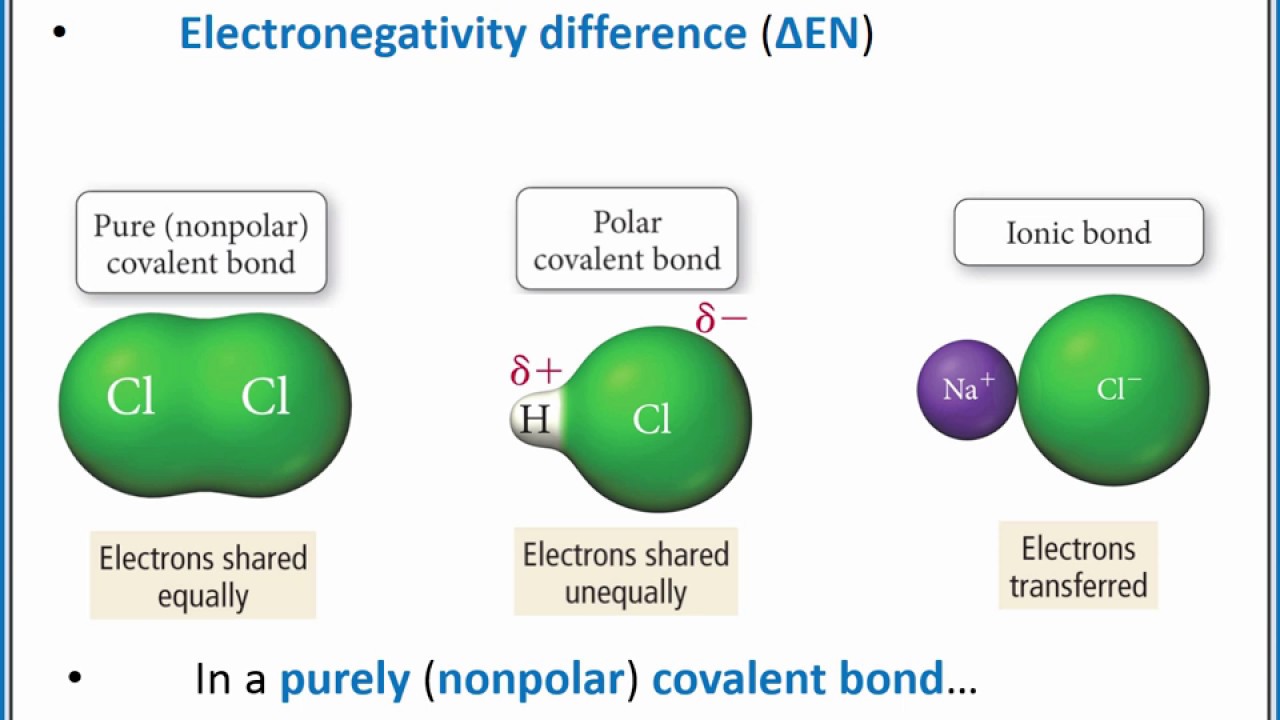
When the difference is very small or zero the bond is covalent and nonpolar. When it is large the bond is polar covalent or ionic.
Chemistry 101 Using Electronegativity To Classify Bonds As Polar Covalent Covalent Or Ionic Youtube
We would expect a very polar bond.
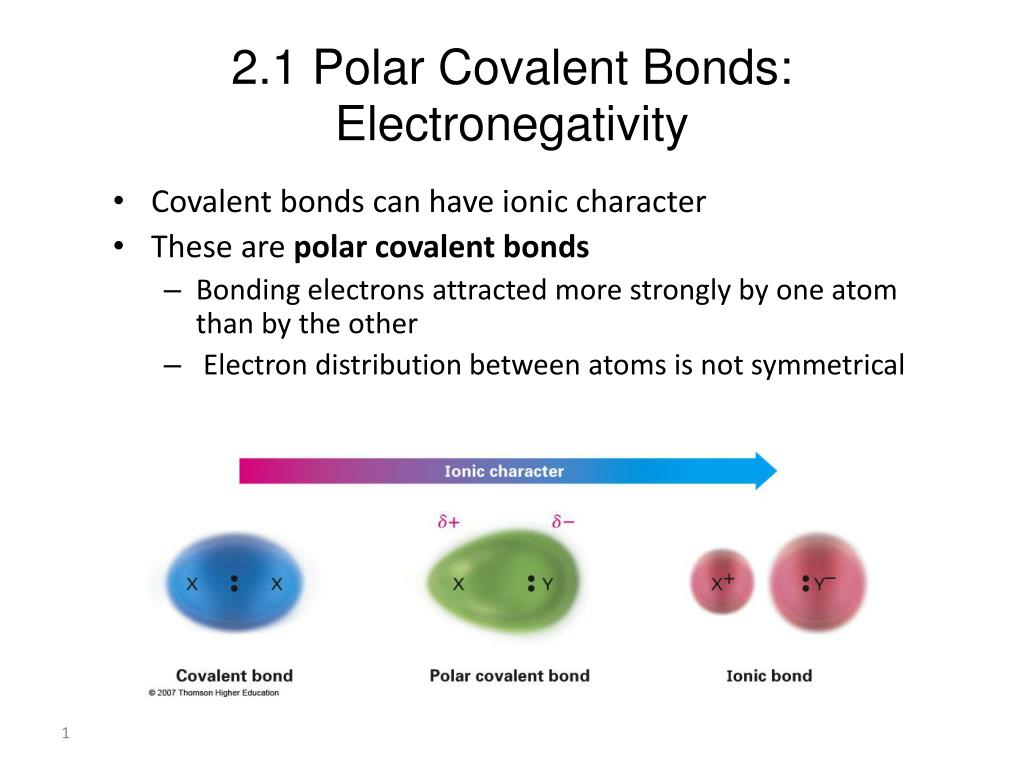
Electronegativity of polar bonds. The absolute value of the difference in electronegativity ΔEN of two bonded atoms provides a rough measure of the polarity to be expected in the bond and thus the bond type. No electronegativity difference between two atoms leads to a pure non-polar covalent bond. In polar covalent bonds the electrons are shared unequally as one atom exerts a stronger force of attraction on the electrons than the other.
This causes the molecule to have a slight electrical dipole moment where one end is slightly positive and the other is slightly negative. The elements with the highest ionization energies are generally those with the most negative electron. The difference is 21 which is rather high and so sodium and chlorine form an ionic compound.
And a partial positive charge on the other atom. In a polar covalent bond sometimes simply called a polar bond the distribution of electrons around the molecule is no longer symmetrical. Covalent bonds are also affected by the electronegativity of the connected atoms which determines the chemical polarity of the bond.
These bond types fall on a spectrum from increasingly ionic to decreasingly polar. Ionic bonds have an electronegativity difference greater than 20. Ina polar covalent bond the more electronegative atom pulls the bond pair towards itself creating a partial negative charge on it.
Bond Polarity and Electronegativity Electronegativity. When it is large the bond is polar covalent or ionic. Polar Bond Definition.
Sodiums electronegativity is 09 while chlorines is 30. The Pauling scale is the most commonly used. A polar covalent bond is a covalent bond in which the atoms have an unequal attraction for electrons and so the sharing is unequal.
Polar bonds and polar molecules. Electronegativity Differences between Metals and Nonmetals. A polar bond is a covalent bond between two atoms where the electrons forming the bond are unequally distributed.
Two atoms with equal electronegativity will make nonpolar covalent bonds such as HH. Thats an electronegativity difference of 20 30 10 making the bond between the two atoms very very polar. A polar covalent bond is a.
Bromine and the other halogens are all more electronegative than hydrogen and so all the hydrogen halides have polar bonds with the hydrogen end slightly positive and the halogen end slightly negative. So lets review the rules. The charge of the electric dipoles is less than a full unit charge so they are considered partial charges and denoted.
A member of group VII of the Periodic Table fluorine chlorine bromine and iodine. If the electronegativity difference usually called ΔEN is less than 05 then the bond is nonpolar covalent. If the ΔEN is greater than 20 then the bond is ionic.
Fluorine the most electronegative element is given a value of 40 and values range down to caesium and francium which are the least electronegative at 07. The ability of an atom to attract a pair of electrons in a chemical bond is called its electronegativity. This page introduces the idea of electronegativity and how electronegativity differences between atoms leads to polar covalent bonds - bonds which arent electrically neutral but have a slightly positive and a slightly negative end.
With 21 for hydrogen and 35 for oxygen the electronegativity difference is 14. Electronegativity and Bond Polarity The electronegativity difference between two bonded atoms helps characterize a bond as ionic polar covalent or nonpolar covalent. An elements electronegativity provides us with a single.
A large electronegativity difference leads to an ionic bond. If the ΔEN is between 05 and 16 the bond is considered polar covalent 3. A small electronegativity difference leads to a polar covalent bond.
If the electronegativity is less than 05 then it is nonpolar. Electronegativity is a measure of tendency of an atom to attract a bonding pair of electrons. However polarity also requires geometric asymmetry.
Electronegativity is a measure of the tendency of an atom to attract a bonding pair of electrons. An unequal relationship creates a polar covalent bond such as with HCl. Polar Covalent Bonds In a normal covalent bond the bond pair is shared equally.
The Pauling scale is most commonly used. Sodium has an electronegativity of 10 and chlorine has an electronegativity of 30. If the molecule has a charge we designate it as ionic no matter what the electronegativity.
If the electronegativity difference is greater than or equal to 050 then the bond is polar. A bond in which the electronegativity difference between the atoms is between 05 and 21 is called a polar covalent bond. The difference in electronegativity between two atoms determines how polar a bond will be.
After the geometry is determined the electronegativity of the bonds are calculated from the data on the reverse side of the periodic table.