Deductive reasoning for dummies. On the other hand inductive logic or reasoning involves making generalizations based upon behavior observed in specific cases.
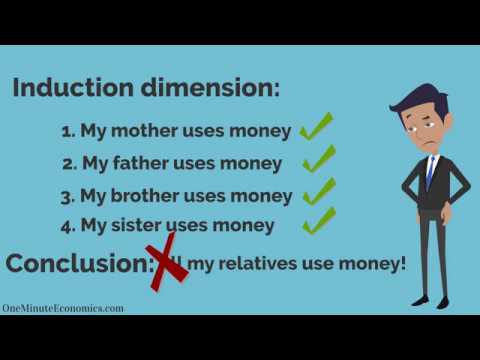
Deduction Vs Induction Deductive Inductive Reasoning Definition Meaning Explanation Examples Youtube
Published on April 18 2019 by Raimo Streefkerk.

Deductive reasoning for dummies. Reasoning is a special mental activity called inferring what can also be called making or performing inferences. A logical inference is a connection from a first statement a premise to a second statement the conclusion for which the rules of logic show that if the first statement is true the second statement should be true. Deductive reasoning involves inferring that if propositions A and B are both true then this implies that C is also true.
In fact its tailor-made for sifting through a body of factual statements premises ruling out plausible but inaccurate statements invalid conclusions and getting to the truth valid conclusions. The main difference between inductive and deductive reasoning is that inductive reasoning aims at developing a theory while deductive reasoning aims at testing an existing theory. An example of deductive reasoning in action.
Therefore the teacher will use ppt tomorrow. Deductive reasoning You can do deductive reasoning while sitting in your armchair. Ordinary deductive reasoning is monotonic in the sense that if a proposition P can be inferred from a set of premises B and if B is a subset of A then P can be inferred from A.
Because the statements are true we know that the conclusion we make based. In this reasoning process a person starts with a known claim or a general belief and from there asks what follows from these foundations or how will these premises influence other beliefs. For this reason logic and deduction are intimately connected.
Revised on November 11 2019. Deductive Reasoning Deductive reasoning means we can draw a conclusion based on at least two true statements or premises. Deductive reasoning is reasoning where true premises develop a true and valid conclusion.
The classic example is over two thousand years old and involves the question of whether the ancient Greek philosopher Socrates was mortal. For example given that a certain quadrilateral is a rectangle and that all rectangles have equal diagonals what can you deduce about the diagonals of this specific rectangle. Deductive reasoning uses given information premises or accepted general rules to reach a proven conclusion.
Deductive reasoning in geometry is much like the situation described above except it relates to geometric terms. Deductive reasoning top-down reasoning is a logical process where a conclusion is based on the concordance of multiple premises that are generally assumed to be true. In place of word premises you can also put.
Deductive reasoning is a type of deduction used in science and in life. It is when you take two true statements or premises to form a conclusion. Also called deductive logic this act uses a logical premise to reach a logical conclusion.
Deductive reasoning is the process of drawing a conclusion based on premises that are generally assumed to be true. Scientists use inductive reasoning to create theories and hypotheses. Example of Deductive Reasoning.
But did you know theyre core pillars of our thought processIn othe. Deduction and induction are two words youve surely come across relatively frequently. In other words in monotonic reasoning an inference never has to be canceled in light of further inferences.
Deductive reasoning that is based on a general statement of fact is hard to. The following is a useful and simple definition of the word infer. Logic allows you to reason deductively with confidence.
They are equal of course. Deductive reasoning is often referred to as top-down reasoning. B is also equal to C.
For example you might say all animals need oxygen because this is true of every animal it is true of each animal as well. Deductive reasoning or deduction is one of the two basic types of logical inference. Deductive arguments are either valid or invalid.
For example A is equal to B. Deductive reasoning is one of the most basic forms of logical processing. In opposition deductive reasoning is a basic form of valid reasoning.
Deductive reasoning is the method by which conclusions are drawn in geometric proofs. Given those two statements you can conclude A is equal to C using deductive reasoning. Deductive reasoning works from the more general to the more specific.
That is to say that deduction is one of the fundamental ways we as humans form conclusions based on the information available to us. Inductive reasoning moves from specific observations to broad generalizations and deductive reasoning the other way around. To inferis to draw conclusions from premises.
This type of reasoning involves drawing specific conclusions from general statements premises. In the case of deductive reasoning the conclusion must be true if the premises are also true.