Descartes Rule of Signs do not determine actual number of real positive or real negative roots of an algebraic equation but it indicates only the maximum limit of the number of real positive or negative roots of an equation. It is possible that some of the roots will be imaginary.

Descartes Rule Of Signs
If two negative real roots then there is zero imaginary roots but if zero negative real.
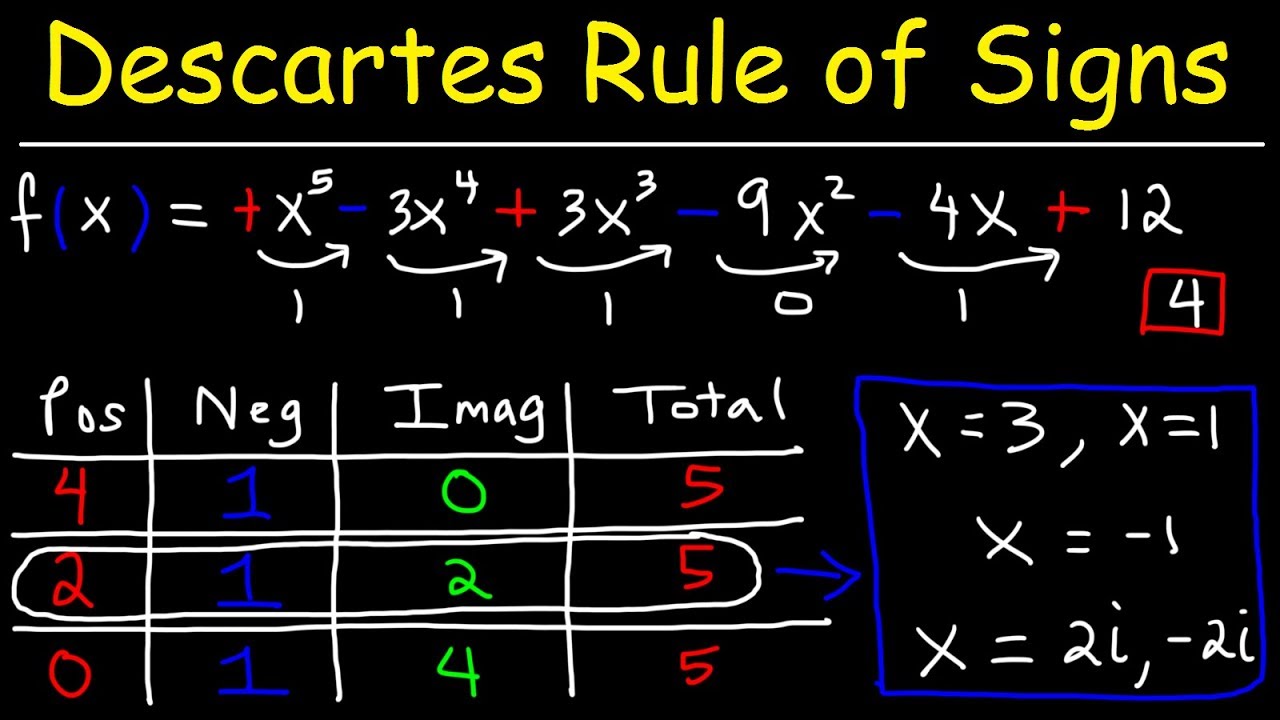
Descartes rule of signs imaginary roots. Every polynomial equation with complex coordinates and a degree greater than zero has at least one root in the set of complex numbers. It tells us that the number of positive real zeroes in a polynomial function f x is the same or less than by an even numbers as the number of changes in the sign of the coefficients. For the number of negative real roots find f x and count again.
I imaginary unit Operations. This topic isnt so useful if you have access to a graphing calculator because rather than having to do guess-n-check to find the zeroes using the Rational Roots Test Descartes Rule of Signs synthetic division and other tools you can just look at the picture on the screen. It is also shows us the connection between the amount of real zeros and sign changes.
If the polynomial is written in descending order Descartes Rule of Signs tells us of a relationship between the number of sign changes in displaystyle fleft xright f x and the number of positive real zeros. Descartess rule of signs in algebra rule for determining the maximum number of positive real number solutions roots of a polynomial equation in one variable based on the number of times that the signs of its real number coefficients change when the terms are arranged in the canonical order from highest power to lowest power. Descartes Rule of Signs.
This tells us that the function must have 1 positive real zero. Descartes Rule of Signs stipulates that the constant term of the polynomial fx is different from 0. Ex ex lnx logx lnx lnxlna log_ax Trigonometric Functions.
Ab ab ab ab ab sqrtx x12 sqrtx cbrtx x13 root3x rootxn x1n rootnx xab xab xab xab absx x Functions. The rule is actually simple. Descartess rule of signs says the number of positive roots is equal to changes in sign of f x or is less than that by an even number so you keep subtracting 2 until you get either 1 or 0.
Descartes rule of sign is used to determine the number of real zeros of a polynomial function. Statement of Descartes Rule of Signs Let f x a n x n a n 1 x n 1 a 0 fx a_nxn a_n-1xn-1 cdotsa_0 f x a n x n a n 1 x n 1 a 0 be a polynomial with real coefficients. Descartes Rule of Signs is a useful help for finding the zeroes of a polynomial assuming that you dont have the graph to look at.
However not all of the roots of the function have to be real roots. This implies in particular that if the number of sign changes is zero or one then there are exactly. Therefore there may be two negative real roots or zero negative real roots.
Descartes Rule of Signs can be used to determine the number of positive real zeros negative real zeros and imaginary zeros in a polynomial function. Descartes Rule of Signs The degree of a polynomial function identifies the number of roots that it will have. How to use Descartes Rule of Signs to determine the number of positive real zeros negative real zeros and imaginary zeros005 Explanation of the purpose o.
The Descartes Rule of Signs is a rule that is mainly used for finding the amount of zeros no imaginary in a polynomial function. If the constant term is 0 as in the equation x 4 3x 2 2x 2 5x0 we factor out the lowest power of x obtaining x x 3 3x 2 2x5 0. In mathematics Descartes rule of signs first described by René Descartes in his work La Géométrie is a technique for getting information on the number of positive real roots of a polynomial.
A polynomial equation with degree n will have n roots in the set of complex numbers. The purpose of the Descartes Rule of Signs is to provide an insight on how many real roots a polynomial Pleft x right P x may have. There are two sign changes.
The number of negative real zeroes of the f x is the same as the number of changes in sign of the coefficients of the terms of f -x or less than this by an even number. It asserts that the number of positive roots is at most the number of sign changes in the sequence of polynomials coefficients and that the difference between these two numbers is always even. Sinx sinx cosx cosx tanx tanx tgx cotx cotx ctgx secx secx cscx.
Therefore the previous f x may have 2 or 0 positive roots. For example the polynomial function below has one sign change. This precalculus video tutorial provides a basic introduction into descartes rule of signs which determines the nature and number of the solutions to a polyn.
We are interested in two kinds of real roots namely positive and negative real roots. This rule can also indicate the existence and minimum number of imaginary roots for equations with real coefficients.

Homework Log Wed 1 6 Lesson 5 3 Learning Objective To Apply The Fundamental Theorem Of Algebra Descartes Rule Of Signs Hw 505 Pg 293 1 25 Odd Ppt Download

How To Use Descartes Rule Of Signs With Examples Owlcation Education

The Fundamental Theorem Of Algebra Descartes Rule Of Signs If F X Is A Polynomial Function With Real Coefficients Then The Number Of Positive Real Ppt Download
Descartes Rule Of Signs Youtube
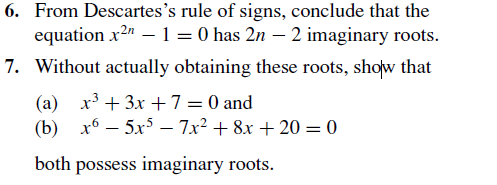
Solved From Descartes Rule Of Signs Conclude That The E Chegg Com